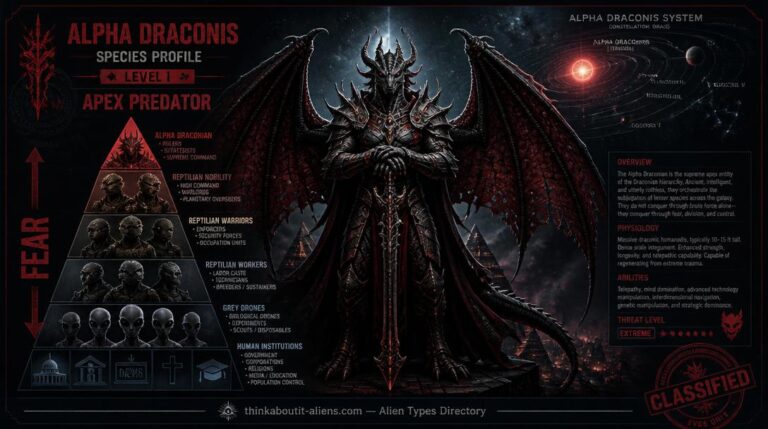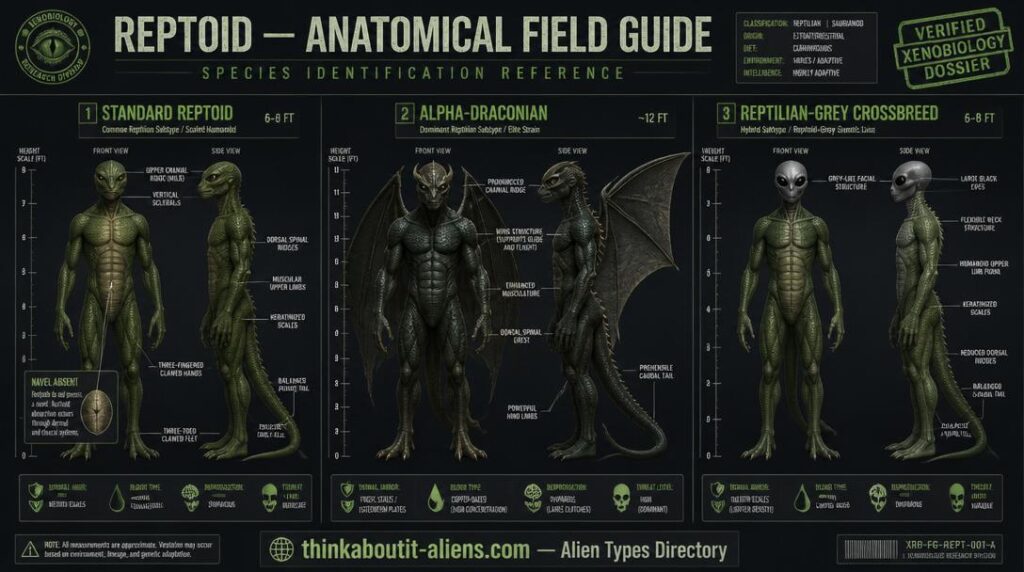
The Reptoid anatomical field guide — standard Reptoid, winged Alpha-Draconian, and Reptilian-Grey crossbreed shown in clinical profile with identification callouts.
What do Reptilians actually look like? This concise anatomical field guide — compiled from thousands of eyewitness reports across the abduction, contact, and encounter literature — provides the most detailed physical profile of Reptoid and Draconian entities available on the Think About It network. The standard Reptoid is described as six to eight feet tall, muscular, with green-to-brown scaled skin, vertical-slit pupils, clawed hands with three or four digits, no visible external ears, no navel (suggesting non-mammalian birth), and a ridge or row of bony protrusions running from the crown of the skull down the spine — a feature one researcher compares to the Australian Bearded Dragon lizard. The Draconian subtype adds bat-like wings, greater height (up to 12 feet), and a more pronounced cranial ridge.
The article distinguishes between several reported subtypes: the standard bipedal Reptoid (most commonly encountered in abduction scenarios), the winged Alpha-Draconian (described as the command/royal caste), and Reptilian-Grey crossbreeds (hybrid entities combining Grey facial features with Reptilian body structure). The absence of a navel across all reported Reptoid types is flagged as a significant biological marker — suggesting either egg-based reproduction or clonal generation rather than placental birth. For researchers building a working physical identification profile for Reptilian-type entities, this field guide provides the baseline reference.
Reptilians / Reptiods
These physical descriptions are compiled from a large database on reptilian-human contacts. In some cases, the experiencer may recall only one physical characteristic of the nonhuman entity that was encountered. On the other hand, other people have vivid memories of their encounter and are able to provide detailed reports of the reptilian beings anatomy.
The following is a compilation of these eyewitness descriptions for your review. Generally speaking, there are three basic reptilian physical types.
The Reptoid (reptilian-humanoid crossbreeds), the various reptilian-grey crossbreed types and the hierarchical reptilian overlords called the Draco (winged reptilian beings).
Although the reptilian being species are divided into three basic types, there are physical features that are shared by almost all. These commonalities will be covered under the description of the Reptoid beings.
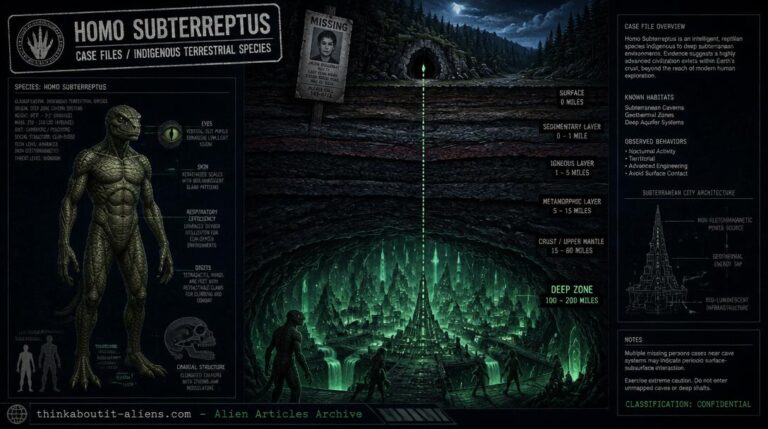
Reptilian beings range from five and a half to nine feet in height. They have lean, firm bodies with powerful arms and legs. They have long arms with three fairly long fingers and an opposable thumb. Their feet have three toes and one recessed fourth toe that is toward the back side of their ankle. The claws of their hands and feet are short and blunt. They do not have teats on their upper torso and they do not have a navel.
REPTOID
They have scaled skin that is usually greenish-brown in color. Some also have coffee colored scales that have dark green colored rims. The scales (or scutes) on their backs, thighs and upper arms are large. Their hands, abdomen and face, are covered with smaller scales, allowing more flexibility. They have wide lipless mouths which contain differentiated types of teeth, including canines (fangs.)
They have either large black eyes with vertical slit pupils or eyes that white with flame colored vertical slit pupils. Their heads are slightly conical in shape and have two bony ridges riding from their brow, across their back sloping skull, toward the back of their head. Throughout history, these bony ridges have been misidentified as horns.
There appears to be no bridge between their eyes. The nasal openings are at the end of a small, flattened nose and are described as two small slits that slant upwards in a V formation. Some experiencers have reported seeing small openings on the sides of their heads, but have noted that there is no fleshy part extending from this area. Reptilian beings have no body or facial hair.
Occasionally, experiencers will have observed reptilian beings with thin, fleshy spines under their chins. From a distance, this physical feature is often misidentified as hair. (Even today, one can find lizards with these same fleshy spines under their chins. They are called Bearded Lizards.)
Reptilian beings are both tailed and tailless. The tails are differentiated in size and are held off the ground. Their posterior can be like either that of a human, with a vertical slit shielding an excretory orifice or it can be a rounded muscular area extending from the base of the spine to the upper thigh region. Experiencers have reported seeing reptilian beings with a combination of these posterior configurations. Their genitalia are concealed within a vertical slit located at the base of the torso. In the case of women who claim to have experienced sexual encounters with reptoids, the male reptilian beings are described as having a well endowed penis that is lacking a soft sacked scrotum.
Where the scrotum sack is located on a human, the reptilian male, apparently, has a firm, muscular bulge leading from the base of the penis to the underside of the torso.
Executive Summary:
Reptilians / Reptiods — Anatomical Field Guide, Subtypes, and the No-Navel Marker
This field guide compiles the consistent physical characteristics reported across thousands of Reptoid encounter cases: 6–8 foot height, green-to-brown scaled skin, vertical-slit pupils, clawed 3–4-digit hands, no external ears, no navel, and dorsal spinal ridges. Three subtypes are distinguished: standard Reptoid (most common), winged Alpha-Draconian (command caste, up to 12 feet), and Reptilian-Grey crossbreeds (hybrid morphology). The no-navel marker is flagged as a key biological indicator of non-mammalian reproduction.
The guide serves as the physical identification baseline for the Drac-Reptilian species directory on thinkaboutit-aliens.com, complementing the behavioral and political profiles documented in other articles in the Scaly Type archive.
“No navel, no external ears, vertical-slit pupils, and a row of bony spines from crown to tailbone — the Reptoid physical profile is remarkably consistent across thousands of independent witness reports.”
About the Author