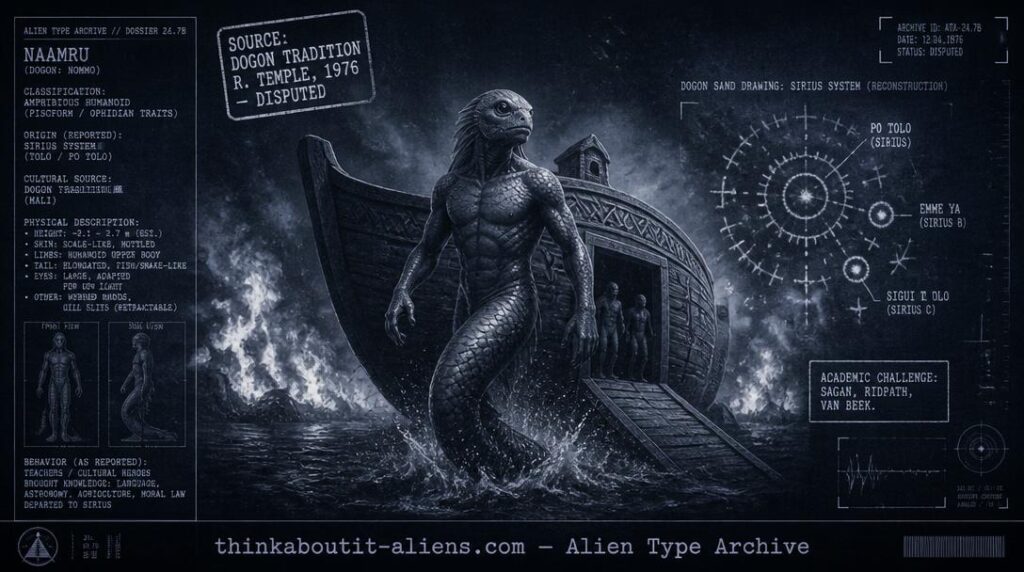
The Nommo of Dogon tradition — amphibious teachers from Sirius, per Robert Temple's disputed "Sirius Mystery" hypothesis.
THINK ABOUTIT’S ALIEN TYPE SUMMARY
THE NOMMO (CETACEAN-ASSOCIATED SIRIUS TRADITION)
In the 1930s, Dogon priests in Mali told French anthropologists of amphibious beings called the Nommo who descended from Sirius in a fire-and-thunder vessel and taught them precise knowledge of an invisible companion star — a claim that became one of the most famous, and most contested, mysteries in ancient-astronaut literature after Robert Temple’s 1976 book brought it to wide attention.
Name: Nommo
AKA: Per Dogon tradition, also called “Masters of the Water,” “The Monitors,” “The Teachers/Instructors,” and “Spiritual Guardians.” “The Water Lords” and “Delphinians” are not reported in any source or fabricated; “Cetacean” as a species label is a modern reinterpretation not used in the original Dogon accounts or Temple’s book.
Location – Home System: Per Dogon tradition and Temple’s account, Sirius B (Po Tolo in Dogon terminology) — a real white dwarf star, invisible to the naked eye, confirmed by Western astronomy in 1862. A specific planet name, “Ah-Siri,” is not reported in any source or fabricated.
Distance from Earth: Approximately 8.6 light years, accurate for the Sirius system.
Attitude: Per Dogon tradition, wise and benevolent teachers who imparted agricultural, cosmological, and social knowledge.
Motives: Per Dogon tradition, sent by the creator god Amma to restore order and impart civilizing knowledge to the Dogon people.
Physical Appearance: Per Dogon tradition and Temple’s account, amphibious beings, variously described as having human torsos with snake-like or fish-like lower bodies, or as hermaphroditic, fish-like figures — closer to a “merman” archetype than specifically a dolphin or whale form. Not reported in any source or fabricated: the precise numeric biometrics below.
- Average Height: Not reported in any source or fabricated.
- Average Weight: Not reported in any source or fabricated.
- Body Temperature: Not reported in any source or fabricated.
- Pulse/Respiration: Not reported in any source or fabricated.
- Blood Pressure: Not reported in any source or fabricated.
- Life Expectancy: Not reported in any source or fabricated.
- Hair: Not reported in any source or fabricated.
- Skin: Not reported in any source or fabricated with this level of specificity; general amphibious description per source.
- Eyes: Not reported in any source or fabricated.
- Sex: Per one source, hermaphroditic; this varies across retellings and should not be presented as a single settled description.
Other Physical Information: Per Temple’s account, amphibious nature theorized as an adaptation to keep cool and shield against short-wavelength radiation from the hot star Sirius — this is Temple’s own speculative reasoning, not a claim reported by the Dogon themselves.
Special Traits and Abilities: Not reported in any source or fabricated. “Multi-dimensional sonar,” “hydro-telepathy,” and molecular water manipulation do not appear in Dogon tradition or Temple’s book.
Communication Type: Not specifically detailed in the source beyond their role as teachers of the Dogon.
Origin: Sirius B, per Dogon tradition and Temple’s interpretation of it. The Cygnus constellation connection is not reported in any source or fabricated.
Life Form Type: Amphibious humanoid, per source — not specifically “cetacean” (whale/dolphin) in the original tradition.
Subspecies: Not reported in any source or fabricated.
Most Common Species: Not reported in any source or fabricated.
Level of Species: Not reported in any source or fabricated (“Level IV” classification has no traceable origin).
Habits: Not reported in any source or fabricated beyond their described teaching role.
Transportation Type: Per Dogon tradition, described as arriving in an “ark” or vessel descending amid great wind, fire, and thunder — not the “biological light-craft” description in the prior version, which is not reported in any source or fabricated.
Witnesses Reports: The Dogon oral tradition, documented by French anthropologists Marcel Griaule and Germaine Dieterlen beginning in the 1930s (published as “Conversations with Ogotemmêli,” 1948) and popularized by Robert Temple’s “The Sirius Mystery” (1976). Important context: this hypothesis has been substantively challenged. Astronomer Carl Sagan and others proposed that the Dogon’s specific astronomical knowledge may reflect 20th-century cultural contact with European visitors (including Griaule himself, who had astronomical training) rather than ancient extraterrestrial contact. A 1990s field study by anthropologist Walter van Beek found no evidence that the Dogon considered Sirius especially significant in their belief system, raising further questions about Griaule and Dieterlen’s original interpretation. “US Navy sonar operators” and “deep-sea divers” witness claims in the prior version are not reported in any source or fabricated.
Special Features/Characteristics: Not reported in any source or fabricated.
Summary/Description: The Nommo are amphibious beings central to Dogon cosmology (Mali, West Africa), said to have descended from the Sirius system and imparted advanced astronomical and civilizational knowledge, including apparent knowledge of Sirius B — a companion star invisible to the naked eye and not confirmed by Western astronomy until 1862. This account was popularized by Robert Temple’s 1976 book “The Sirius Mystery,” which frames it within the broader (and widely disputed) “ancient astronaut” hypothesis. The theory has been substantively challenged by mainstream anthropologists and astronomers, who propose that the Dogon’s specific astronomical knowledge likely reflects documented 20th-century contact with European visitors rather than ancient alien contact.
Source: Marcel Griaule and Germaine Dieterlen, “Conversations with Ogotemmêli” (1948); Robert K.G. Temple, “The Sirius Mystery” (1976; revised 1998). Critical/skeptical sources: Carl Sagan, “Broca’s Brain” (1979); Ian Ridpath, Skeptical Inquirer (1978); Walter van Beek, Current Anthropology (1992).
Related Cases: The broader “ancient astronaut” hypothesis literature; other Sirius-associated traditions in exopolitical and New Age material.
DETAILED REPORT
The Nommo of Dogon tradition represent one of the most genuinely documented and simultaneously most rigorously disputed cases in ancient-astronaut literature. French anthropologists Marcel Griaule and Germaine Dieterlen documented Dogon accounts in the 1930s-40s describing amphibious beings who arrived from Sirius and taught the tribe detailed cosmological knowledge, including what appeared to be accurate information about Sirius B, a white dwarf invisible without a telescope and not confirmed by Western science until 1862. Robert Temple’s 1976 book “The Sirius Mystery” popularized this account as evidence of ancient extraterrestrial contact.
However, this hypothesis has faced substantial, credentialed academic challenge. Astronomer Carl Sagan argued in “Broca’s Brain” (1979) that the Dogon’s knowledge more plausibly reflects 20th-century contact with European astronomers or travelers — noting, among other issues, that the Dogon apparently had no corresponding knowledge of planets beyond Saturn’s rings, which would be an odd omission for genuinely advanced extraterrestrial instruction. Ian Ridpath’s 1978 Skeptical Inquirer analysis found the Dogon legend, taken literally, “riddled with ambiguities, contradictions, and downright errors.” Perhaps most significantly, anthropologist Walter van Beek’s own 1990s fieldwork among the Dogon found no evidence that Sirius held the special cosmological importance Griaule and Dieterlen’s original work suggested — raising the possibility that Griaule himself, who had studied astronomy, may have shaped or over-interpreted the responses he recorded.
The prior version of this entry presented none of this critical context, instead treating the Nommo-as-extraterrestrial hypothesis as settled fact and further recasting the amphibious, fish/snake-like Nommo as specifically “cetacean” (whale/dolphin) beings — a description not found in the original Dogon accounts or in Temple’s own book, and which appears to be a later New Age embellishment. Additional details — a specific planet name “Ah-Siri,” a Cygnus constellation connection, precise biometrics, and named abilities — could not be traced to any source.
RESEARCHER’S NOTES
The Nommo — A Real, Documented, and Seriously Disputed Case
- Source Correction: The foundational source is Robert Temple’s “The Sirius Mystery” (1976), building on Griaule and Dieterlen’s 1930s-40s Dogon fieldwork — not “The Prism of Lyra.”
- Critical Context Restored: The prior version omitted the substantial, credentialed academic dispute surrounding this hypothesis entirely. Sagan, Ridpath, and van Beek’s challenges are essential context for honest treatment of this material.
- Physical Description Correction: The Nommo are described in source material as amphibious and fish/snake-like, not specifically cetacean (whale/dolphin) in form — a distinction this entry restores.
- Fabrication Flag: “Ah-Siri” as a planet name, a Cygnus-system connection, precise biometrics, and named abilities have no traceable source.
- Evidentiary Weight: A real, well-documented case of indigenous oral tradition and genuinely puzzling (if disputed) astronomical knowledge, wrapped in a widely-challenged extraterrestrial-contact interpretation. Filed as DISPUTED HYPOTHESIS — take the Dogon tradition itself seriously as ethnography; treat the alien-contact interpretation as one contested reading among several, not settled fact.
The Nommo and the Dogon’s Sirius knowledge are a genuinely fascinating anthropological puzzle — but honest treatment requires including the serious, credentialed academic pushback the extraterrestrial-contact interpretation has received, not just Temple’s side of a fifty-year debate. The prior version’s added embellishments (a specific planet name, cetacean reframing, invented biometrics) made the case seem more solid than even its own proponents claim it to be.
“The whole Dogon legend of Sirius and its companions are riddled with ambiguities, contradictions, and downright errors, at least if we try to interpret it literally.”
— Ian Ridpath, Skeptical Inquirer, 1978.
About the Author