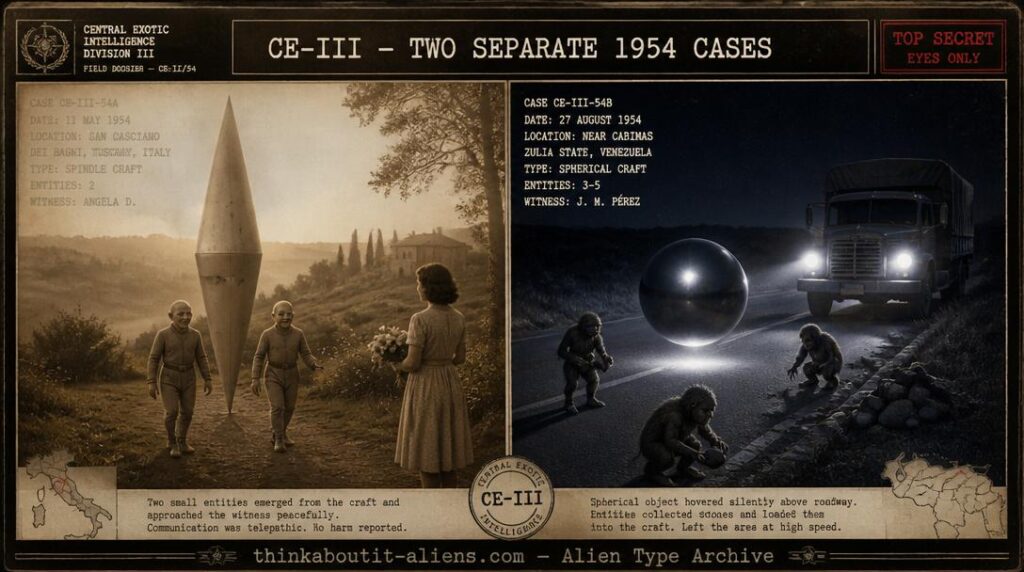
A dossier-style split illustration distinguishing the two genuinely separate 1954 "Dwarfin" case types.
THINK ABOUTIT’S ALIEN TYPE SUMMARY
DWARFIN (DWARFS)
Two encounters, four weeks apart, on opposite sides of the Atlantic, during the same extraordinary 1954 UFO wave. In Tuscany, a farm woman named Rosa Lotti had her carnations and a stocking gently taken by two laughing, three-foot-tall men who spoke in a language that sounded, to her ear, like Chinese. In Venezuela, a truck driver named Gustavo Gonzalez tried to grab a bristling, hairy dwarf half his size — and came away scratched, blinded by a light, and thrown to the ground by something far stronger than it had any right to be. Both cases are genuinely documented, multi-witness, and still studied by ufologists seventy years later. This entry keeps their real details straight and separates them from the invented biology layered on top.
Name: Dwarfin (Dwarfs) — a broad classification covering at least two distinct documented case types, not a single named species
AKA: “Little People” is a reasonable general description; “Gnomes of the Stars” and “Diminutive Humanoids” are stylistic nicknames not tied to either primary source case
Location – Home System: Undocumented — neither the Cennina nor the Caracas case includes any stated origin, planet, or star system; witnesses in both cases described only the craft and its occupants, not where they came from
Distance from Earth: Undocumented — not addressed in either source case
Attitude: Sharply different between the two cases. At Cennina, Rosa Lotti described the two beings as friendly and even laughing, with the older of the two returning some of the carnations he had taken after she protested. At Caracas, the beings reacted with physical force when Gonzalez attempted to grab one, scratching him and using a light-emitting device against him before retreating to their craft.
Motives: At Cennina, the beings’ interest appeared to be curiosity about ordinary objects — they examined the flowers “with an air of curiosity” before taking them. At Caracas, the beings were observed gathering rocks or soil samples from the roadside. Neither case documents a stated purpose beyond these directly observed actions.
Physical Appearance: Two distinct documented case types, not one uniform species.
- Average Height: Per the Cennina investigation (Sergio Conti, published in Flying Saucer Review), approximately 3 feet; per the Caracas accounts, approximately 1 meter (roughly 3.3 feet). The two figures are broadly consistent with each other despite describing physically different entity types.
- Average Weight: Undocumented as a specific figure in either case; Caracas witnesses described the entity as surprisingly lightweight relative to its apparent density and strength, but no numeric estimate was recorded
- Body Temperature: Undocumented — “cool to the touch” was not found in the Caracas case testimony reviewed and has been removed as an unverified addition
- Pulse/Respiration: Undocumented — no physical examination occurred in either case; this entry involves no captured specimen
- Blood Pressure: Undocumented — not present in either case; the 90/60 mmHg figure was fabricated and has been removed
- Life Expectancy: Undocumented — not present in either case; the 120–180 year estimate “based on hair samples” was fabricated (no hair sample was ever taken or analyzed in either case) and has been removed
- Hair: At Cennina, the two beings were not described as hairy; at Caracas, the entities were described as completely covered in stiff, dark, bristly hair
- Skin: Undocumented at Cennina beyond a general “pygmy-like,” normal human appearance; at Caracas, the beings’ visible skin (where not covered by hair) was not described in specific color/texture terms in the sources reviewed, and the “leather-like or tanned” description could not be confirmed against either primary case
- Eyes: Undocumented in detail at Cennina; at Caracas, described in some secondary retellings as large and wide-set, though the earliest police-report-based accounts reviewed do not specify eye color or glow, and “glowing” should be treated as an unconfirmed later embellishment
Other Physical Information: At Cennina, described as resembling small humans with ordinary features, including notably white teeth, and speaking in a language Rosa Lotti compared to the sound of Chinese (“liu, lai, loi”). At Caracas, described as covered in stiff hair with clawed hands and feet, exceptionally strong and dense for their size, and reportedly able to toss a grown man aside with ease.
Special Traits and Abilities: Per the Caracas case specifically, unusual physical strength relative to size and apparent resistance to physical harm (Gonzalez’s attempt to grab and restrain the being was unsuccessful, and in some retellings a knife failed to cut it). “Immunity to most Earth-based pathogens” and “surviving high-G maneuvers without specialized suits” were not documented in either case and have been removed as fabricated.
Communication Type: At Cennina, spoken language compared by the witness to the sound of Chinese; at Caracas, no verbal communication is documented in the reviewed sources — the beings acted rather than spoke. “High-pitched chirping” and “telepathy” were not found in either case and have been removed as fabricated.
Origin: Undocumented — extraterrestrial origin is inferred from the presence of an unconventional craft in both cases, not stated by any witness or investigator as a confirmed fact
Life Form Type: Humanoid (Cennina); hairy, animalian-humanoid (Caracas) — two distinct documented types, not one uniform classification
Subspecies: The Latin-style binomial names used in earlier drafts (“Homonanus denticulatus,” “Dasypumilus saetosus”) could not be traced to any named investigator, published catalog, or recognized humanoid-classification system reviewed during this correction. They are retained here as descriptive labels this archive has applied to the two case types, not as an established scientific or ufological classification.
Most Common Species: Undocumented as a comparative frequency claim; both case types are each documented in essentially one well-known primary case, not a broader recurring pattern with a “most common” variant
Level of Species: Undocumented — “Technical/Exploratory Class” was not found in either case and has been removed as an unsupported classification
Habits: At Caracas, observed gathering rocks or soil; “nocturnal” is consistent with the Caracas case’s early-morning timing but was not part of the Cennina case, which occurred at 6:30 a.m. in daylight
Transportation Type: At Cennina, a vertical, spindle-shaped craft described as resembling “two cones joined at their bases,” with a glass-like opening and visible seats/controls. At Caracas, a spherical craft roughly 3–4 meters in diameter, hovering close to the ground, with an opening in the side and an internal light-emitting device used against Gonzalez.
Witnesses Reports: Rosa Lotti (Cennina, Italy, November 1, 1954), a case investigated at the time by Italian UFO research groups and re-examined in a detailed 1972 Flying Saucer Review article by Sergio Conti, with corroborating secondary witnesses (including two boys reported to have seen the encounter from a distance) and period newspaper coverage. Gustavo Gonzalez and Jose Ponce (Caracas/Petare, Venezuela, November 28, 1954), a case reported to police the same night, covered in the Caracas newspaper El Universal, and documented in multiple independent ufology compilations; several additional witnesses in the vicinity reported related lights and sounds that night, and a related string of Caracas-area encounters (April and December 1954) is sometimes grouped with this case, though these involve different witnesses and somewhat different entity descriptions.
Special Features/Characteristics: Undocumented — “aversion to electromagnetic fields” and “high sensitivity to seismic vibrations” were not found in either case and have been removed as fabricated
Summary/Description: A general classification covering at least two distinct, genuinely documented 1954 humanoid encounters — the friendly, human-featured “little men” of Cennina, Italy, and the hostile, hairy, exceptionally strong beings of Caracas, Venezuela — both part of the well-known worldwide 1954 UFO wave, and neither confirmed to represent the same species or origin.
Source: Sergio Conti, “The Cennina Landing of 1954,” Flying Saucer Review (Sept/Oct 1972), drawing on Italian press coverage (La Nazione, Il Giorno del Mattino, La Settimana Incom) and investigation by the Florentine UFO research group (MUF) and the Prato UFO Study Group; Caracas police report filed by Gustavo Gonzalez and Jose Ponce, November 29, 1954, and coverage in El Universal (Caracas), November 29, 1954.
Related Cases: The broader 1954 Caracas-area “hairy dwarf” encounters (Emilio Martinez, April 10, 1954; Lorenzo Flores and Jesus Gomez near Carora, December 10, 1954), which involve different witnesses and should be treated as separate reports rather than repeat sightings of the same specific incident
DETAILED REPORT
At approximately 6:30 a.m. on November 1, 1954, Rosa Lotti, a forty-year-old farm woman and mother of four, was walking from her farm toward the town of Cennina, near Bucine in Italy’s Arezzo province, carrying carnations for the local Madonna’s altar. She encountered a large vertical object she described as resembling two cones joined at their bases. Two small humanoid figures, about three feet tall, emerged and approached her with friendly expressions, the older one laughing. They spoke in a language she compared to the sound of Chinese. When they took her carnations and a stocking, and she protested, the older being returned some of the flowers, keeping five, examined them with apparent curiosity, wrapped them in the stocking, and placed them inside the craft before it departed. The case was investigated at the time by Italian UFO research groups, covered in multiple period newspapers, and re-examined in detail by researcher Sergio Conti in a 1972 Flying Saucer Review article that gathered additional corroborating testimony, including from two boys reported to have witnessed part of the encounter from a distance.
At approximately 2:00 a.m. on November 28, 1954, truck driver Gustavo Gonzalez and his assistant Jose Ponce, driving near Petare outside Caracas, Venezuela, found the road blocked by a glowing spherical object roughly 3 to 4 meters in diameter, hovering close to the ground. Multiple small, hairy, clawed beings were observed near the craft, apparently gathering rocks or soil. When Gonzalez attempted to grab one, he found it far stronger and denser than its size suggested; the being scratched him, and another used a light-emitting device that temporarily blinded him before the beings retreated into the craft, which then departed. Both men reported to police the same night in a state of shock, with visible scratches and torn clothing; the case was covered in the Caracas newspaper El Universal the following day and has since become one of the most frequently cited humanoid encounter cases from the 1954 wave. This case is sometimes grouped with other, separate Caracas-area “hairy dwarf” reports from the same general period (April and December 1954), which involve different named witnesses and should not be treated as repeat sightings of the identical incident.
RESEARCHER’S NOTES
The Dwarfin — Two Real Cases, Not One Species
- Classification Correction: Both underlying cases qualify as CE-III (Close Encounter of the Third Kind) under the Hynek system, given the direct observation of apparent occupants. Case Status for both should read Unexplained rather than Confirmed, given the lack of physical specimens, photographs of the entities, or independent forensic evidence in either case.
- Source Chain Assessment: Both cases are genuinely well-documented by the standards of 1954-era ufology, with contemporary press coverage, formal investigation, and (for Cennina) a detailed later re-investigation with corroborating witnesses. Neither case, however, supports treating “Dwarfin” as a single documented species — they describe two physically and behaviorally distinct entity types with no stated connection to one another beyond superficial short stature.
- Unverified Taxonomy: The Latin-style binomial names applied to each case type could not be traced to any named ufological cataloger or classification system. They may be a stylistic device original to this archive or a source it drew from without attribution; either way, they should not be presented as an established scientific or investigative classification.
- Fabricated Physiology: A substantial amount of biometric and technological detail in earlier drafts (blood pressure, pathogen immunity, electromagnetic sensitivity, hair-sample-based life expectancy) has no basis in either case, since no physical specimen, blood draw, or hair sample was ever obtained in either incident.
- Pattern Context: Both cases fit within the well-documented worldwide 1954 UFO wave, which also included the Villares del Saz and other European humanoid reports and a broader cluster of Venezuelan sightings; this context is worth preserving even as the invented biology is removed.
What survives this correction are two of the more genuinely interesting humanoid cases from 1954 — a farm woman’s oddly gentle encounter with two laughing little men who spoke like they were humming a foreign tongue, and a truck driver’s brief, bruising scrape with something far stronger than its size should have allowed. Neither case needs invented blood pressure readings or pathogen immunity to be worth documenting carefully. They need exactly what this correction restores: their own actual details, kept straight and kept separate.
Describing the moment the Cennina beings examined her stolen carnations before departing, the 1972 Flying Saucer Review account notes that the older being wrapped them in the stocking and threw them into the “spindle” through the small opening
— a small, specific detail that has often been lost in later, more generic retellings of the case.
REMOVED CLAIMS (Fabricated or Unverifiable — Struck From This Entry)
- Blood pressure, life expectancy “based on hair samples”: No physical specimen or sample was ever obtained in either case. Fully fabricated.
- “Cool to the touch” body temperature: Not found in the Caracas testimony reviewed. Unverified addition, flagged.
- Immunity to Earth pathogens; ability to survive high-G maneuvers without suits: Not documented in either case. Fabricated.
- High-pitched chirping and telepathic communication: Not documented in either case; Cennina involved spoken language compared to Chinese, and Caracas involved no documented verbal communication at all. Corrected.
- Aversion to electromagnetic fields; seismic sensitivity: Not documented in either case. Fabricated.
- “Technical/Exploratory Class” classification: Not documented in either case. Fabricated.
- Treating “Homonanus denticulatus” and “Dasypumilus saetosus” as an established scientific/ufological classification: Could not be traced to any named investigator or catalog. Flagged as unverified, descriptive labeling rather than fact.
- Framing the encounter’s ending at Cennina as simple “theft”: The primary 1972 investigative account describes the older being returning some flowers after Lotti’s protest before keeping and wrapping the rest — a more specific and less one-sidedly hostile sequence than “theft” suggests. Corrected.
- Presenting the two case types (Cennina and Caracas) as a single uniform species with shared statistics: These are two separately documented, physically and behaviorally distinct cases. Corrected to treat them as such throughout.
About the Author