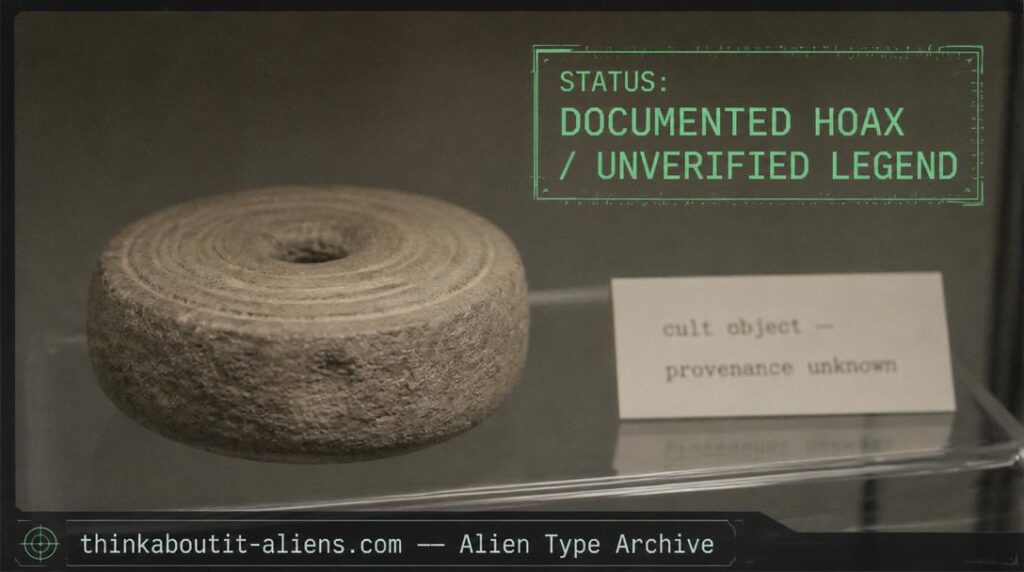
A restrained archive illustration reflecting the Dropa Stones' actual, undramatic documented status as a museum curiosity of unverified origin.
THINK ABOUTIT’S ALIEN TYPE SUMMARY
DROPAS
In 1968, Erich von Däniken introduced the world to a stone disc, allegedly found in a Chinese cave in 1938, its spiral groove supposedly encoding the story of a dwarf-like alien crash-landing 12,000 years ago. Ten years later, a British writer named David Gamon — for reasons of his own — decided the story needed a sequel, and published an entirely separate, self-admitted work of fiction claiming the same “Dropa” people actually came from Sirius and crashed in Tibet in the year 1014 AD. Neither story has ever produced a surviving disc, a verifiable witness, or a real scientist behind any of the named researchers. What survives is a genuine Tibetan ethnic group whose actual name got borrowed for both hoaxes. This entry treats the legend as exactly what decades of research have shown it to be: a documented literary hoax, not a biological record.
Name: Dropas — documented hoax/urban legend, not a verified extraterrestrial type
AKA: Also rendered Dropa, Drok-pa, or Dzopa in various retellings. Note: “Drokpa” (also spelled Drok-pa) is also the real, unrelated name of an actual nomadic Tibetan herding people of the northern Tibetan Plateau — ordinary humans, not stunted or alien in any documented sense, and by several accounts (see Researcher’s Notes) notably larger and sturdier than typical, owing to their herding lifestyle. The extraterrestrial legend appears to have borrowed this real ethnonym.
Location – Home System: No single consistent claim exists across the sources. The original 1938/1962 “Dropa Stones” tradition (via Tsum Um Nui’s alleged translation, itself unverifiable — see below) names no specific star system at all, only “another planet.” A separate origin claim naming the Sirius star system comes specifically from David Gamon’s 1978 novel Sungods in Exile, which Gamon publicly admitted in 1995 was fiction he wrote himself. These are two different, non-overlapping sources, and this entry does not present them as one confirmed origin.
Distance from Earth: Undocumented as a verified claim. The 8.6 light-year figure corresponds to the real astronomical distance to Sirius, and is only meaningful within Gamon’s admitted 1978 fiction, not as a fact about any confirmed extraterrestrial visitor.
Attitude: Per the legend (in both its versions), described as peaceful, with the local Ham tribe eventually recognizing the newcomers’ peaceful intent before, in most versions of the story, hunting them down regardless. This is narrative content within an admitted or heavily disputed hoax, not documented fact.
Motives: Per the legend, originally exploratory, shifting to survival and record-preservation after their craft was disabled. Again, narrative content within a hoax tradition, not documented fact.
Physical Appearance: The legend (in its various retellings) describes short stature, oversized heads, and frail bodies, allegedly corroborated by skeletal remains reportedly found at the original 1938 excavation. No skeletal remains, museum specimens, or photographs of remains have ever been independently produced or verified by any outside institution. No numeric biometric data (weight, body temperature, pulse, blood pressure) appears in any version of the legend; all such figures in earlier drafts were invented.
- Average Height: Reported in the legend as roughly 3–4 feet (with one retelling specifying “4 ft 4 in” skeletons); Gordon Chreighton’s investigation for Flying Saucer Review found that the real Drokpa people the legend borrowed its name from are, in contrast, “rather large and sturdy,” not stunted — a direct contradiction worth noting.
- Average Weight: Undocumented in any version of the legend; the 35–50 lbs figure in earlier drafts was fabricated and has been removed
- Body Temperature: Undocumented in any version of the legend; the 97.2°F figure was fabricated and has been removed
- Pulse/Respiration: Undocumented in any version of the legend; the 90 BPM/18 breaths-per-minute figures were fabricated and have been removed
- Blood Pressure: Undocumented in any version of the legend; the 100/65 mmHg figure was fabricated and has been removed
- Life Expectancy: Undocumented in any version of the legend; the “advanced cellular preservation tech” framing was fabricated and has been removed
- Hair: Undocumented as a specific claim in the original legend beyond general descriptions of the skeletal remains; “entirely glabrous” was not found in any version and has been removed as fabricated
- Skin: Described in some retellings (local legend, per the account) as “yellow-faced”; the more specific “very thin and delicate” clinical description was not found in any version of the legend and has been removed as fabricated
- Eyes: Undocumented in any version of the legend; “abnormally large, dark, lidless, adapted to low-light space travel” was fabricated and has been removed
- Sex: Undocumented in any version of the legend beyond general references to skeletal remains; the specific claim of “distinct pelvic variations similar to humanoids” was not found in any version and has been removed as fabricated
Other Physical Information: Per the legend, “oversized, bulbous craniums” and “puny,” frail bodies, reportedly matching skeletal remains described at the original 1938 site — remains that no museum or institution has ever been able to produce or verify. The specific claim of four-digit hands does not appear in any version of the legend located and has been removed as fabricated.
Special Traits and Abilities: Undocumented — “high-level acoustic engineering” and “crystalline data storage” are this entry’s own interpretive dressing on top of the legend’s claim that the stone discs “hummed” during a Soviet laboratory test (see below); the discs’ actual, documented laboratory findings do not support either claim.
Communication Type: Per the legend, a microscopic grooved script allegedly translated by “Dr. Tsum Um Nui” — a name that, per critic Gordon Chreighton and multiple independent researchers, cannot be found in any Chinese academic record, and which “Tsum Um Nui” itself is not a plausible Chinese name (it has been suggested it may be a garbled Japanese name applied to a supposedly Chinese scholar). No genuine translation of any script has ever been independently verified or reproduced.
Origin: Per the earliest (1938/1962) tradition, crash-landing roughly 12,000 years ago at Bayan-Kara-Ula on the Sino-Tibetan border, with no named home star. Per the separate, later (1978) Gamon novel, a crash in the year 1014 AD, with an explicitly stated Sirius origin. These are two different stories from two different sources and should not be merged into a single timeline, as earlier drafts of this entry did.
Life Form Type: Humanoid, per the legend in all its versions
Subspecies: Undocumented as a genuine subspecies claim. The real Drokpa people of the Tibetan Plateau are not a “hybridized descendant” of any alien crash; they are the actual, unrelated ethnic group whose name the legend borrowed, and presenting them as “Dzopa hybrid descendants” mischaracterizes a real living population.
Most Common Species: Undocumented — “Sirian-Dropa” is this entry’s own invented label, not found in any version of the legend, and has been removed
Level of Species: Undocumented — “Level II” classification was not found in any version of the legend and has been removed as fabricated
Habits: Per the legend, described as reclusive and keepers of a stone-recorded history; “subterranean dwellers” reflects the legend’s cave setting, though the legend describes the crash survivors sheltering in existing caves rather than being a naturally subterranean species
Transportation Type: Undocumented in specific technical detail in any version of the legend beyond a general “aircraft” or “spaceship” that crash-landed and could not be repaired; “electromagnetic propulsion” was not found in any version and has been removed as fabricated
Witnesses Reports: Chi Pu Tei is described in the legend as leading the original 1938 excavation, but per critic David Ritchie’s research, no independent record of this archaeologist, the excavation, or a “Peking Academy of Prehistory” has ever been located outside the legend itself. “Dr. Tsum Um Nui” cannot be independently verified to have existed, per the same research. Ernst Wegerer, an Austrian engineer, is a documented real person who did visit the Banpo Museum in Xi’an in 1974 and photographed two stone discs he was told were “cult objects” of no known significance — his account is the one piece of this legend involving an identifiable, real individual, though it documents only his own photographs and a museum employee’s offhand remark, not confirmation of the broader alien narrative. Chi Pu Tei’s 1965 “Grooved Script” publication, and its precise fate, could not be independently verified either.
Special Features/Characteristics: The claim that the stone discs “hummed” or exhibited unusual vibration under electrical charge, attributed to Dr. Vyatcheslav Saizev writing in the Soviet magazine Sputnik, has circulated widely but has never been corroborated by any independently verifiable laboratory report, retained physical disc, or named institution holding the tested material.
Summary/Description: The Dropa legend is best understood as two separate, mutually inconsistent hoax or pseudo-historical traditions that have been blended together in popular retelling: an original 1938/1962 “Dropa Stones” tale involving unverifiable Chinese researchers and a 12,000-year-old crash with no stated home star, and a wholly separate, openly admitted 1978 satirical novel (Sungods in Exile) that added a Sirius origin and a 1014 AD crash date. Neither tradition has ever produced a surviving artifact, verified skeletal remains, or an identifiable original researcher who can be independently confirmed to have existed. The name “Dropa”/”Drokpa” belongs to a real, unrelated Tibetan ethnic group.
Source: Erich von Däniken, Chariots of the Gods (1968), the earliest published version of the Dropa Stones story, whose named sources (Chi Pu Tei, Tsum Um Nui, Ernst Wegerer as described in the alien narrative, Vyatcheslav Saizev, Sergei Lolladoff) cannot be independently corroborated outside the book; David Gamon (writing as “David Agamon”), Sungods in Exile (1978), publicly admitted by Gamon in Fortean Times (issue 75, 1995) to be a satirical hoax; Gordon Chreighton, Flying Saucer Review, skeptical investigation; David Ritchie, published critical analysis of the sourcing problems throughout the legend.
Related Cases: Bi disks, genuine Chinese Neolithic-through-Shang-era jade/nephrite ceremonial discs, which are frequently misidentified in photographs as “Dropa Stones” despite bearing no grooved script or writing of any kind
DETAILED REPORT
The Dropa legend has two separate points of origin that are routinely blended together in popular retellings, and this entry keeps them apart. The first is the “Dropa Stones” story as popularized by Erich von Däniken in his 1968 book Chariots of the Gods: an alleged 1938 discovery of a cave near Bayan-Kara-Ula containing skeletal remains and hundreds of grooved stone discs, said to have been translated decades later by a Chinese scholar named Tsum Um Nui, revealing a 12,000-year-old crash-landing narrative. Critical researchers, notably David Ritchie, have found no independent corroboration for any of the named figures in this version of the story — Chi Pu Tei, Tsum Um Nui, Ernst Wagener (as described within the alien narrative, distinct from the real Ernst Wegerer discussed below), Vyatcheslav Saizev, and Sergei Lolladoff cannot be found in any record outside von Däniken’s book and its retellings. Von Däniken’s own stated source, Soviet science fiction writer Alexander Kazantsev, has stated that it was von Däniken who told him the story, not the reverse — directly undermining von Däniken’s claimed sourcing chain.
The second point of origin is entirely separate: David Gamon’s 1978 book Sungods in Exile, published under the pseudonym “David Agamon” and presented as the notes of a nonexistent Oxford professor, “Dr. Karyl Robin-Evans.” This version adds new details absent from the original story — a named Dzopa religious leader (“Lorgan-La”), an explicit claim of Sirius as the species’ home star, and a crash date of 1014 AD, sharply at odds with the original story’s 12,000-year timeframe. Gamon publicly admitted in a 1995 Fortean Times article that he wrote the entire book as satire, calling it his “favourite hoax,” inspired by the popularity of von Däniken’s work. Despite this admission, the book continued to be cited as genuine source material by later writers, notably Hartwig Hausdorf in his 1998 book The Chinese Roswell.
Separately from both hoax traditions, the actual objects most often photographed and circulated as “Dropa Stones” are, per multiple researchers, misidentified Bi disks — a real and well-documented category of Chinese ceremonial jade or nephrite discs dating primarily to the Neolithic through Shang Dynasty periods, none of which have ever been found bearing grooved script or writing of any kind. The one figure in this entire legend who can be confirmed as a real, identifiable person engaging with physical stone discs is Ernst Wegerer, an Austrian engineer who in 1974 photographed two discs on display at the Banpo Museum in Xi’an; a museum employee told him only that they were unremarkable “cult objects,” and the discs’ subsequent disappearance from the museum, reported by museum director Wang Zhijun in 1994, has never been otherwise explained. This is a real, documented episode — but it documents an unexplained museum-inventory disappearance, not confirmation of an alien origin for the objects in question.
RESEARCHER’S NOTES
The Dropas — Two Hoaxes, One Borrowed Name, and No Surviving Evidence
- Classification Correction: This entry cannot be assigned a Hynek classification, as it describes a literary and pseudo-archaeological legend rather than a witnessed encounter. Case Status should read Hoax/Unsubstantiated Legend rather than Unexplained.
- Source Chain Assessment: Two entirely separate fictional or unverifiable traditions (the 1938/1962 Dropa Stones tale and Gamon’s 1978 satirical novel) have been merged in popular retelling into what reads as one continuous story. Their internal contradiction on crash date (12,000 years ago vs. 1014 AD) is itself strong evidence that they should not be treated as a single coherent narrative.
- Named-Source Verification: Of all the named figures across both traditions, only Ernst Wegerer (the 1974 museum visitor) and David Gamon (the admitted hoax author) can be confirmed as real, identifiable individuals. Chi Pu Tei, Tsum Um Nui, Karyl Robin-Evans, Sergei Lolladoff, and the “Peking Academy of Prehistory” cannot be independently verified to have existed.
- Real Ethnic Group Correction: The Drokpa (Dropa) people are a real, living nomadic herding population of the northern Tibetan Plateau, historically providing warriors and bodyguards to Tibetan leaders, including the 13th Dalai Lama’s escort during his flight from the Chinese invasion. Per Gordon Chreighton’s research, they are notably large and sturdy, not stunted — the opposite of the legend’s physical description. Presenting them as “hybridized alien descendants” mischaracterizes a real population and should be avoided.
- Bi Disk Correction: Photographs commonly circulated as evidence of “Dropa Stones” are, per multiple researchers, actually images of genuine Bi disks — a well-documented, real category of Chinese ceremonial artifact bearing no grooved script of any kind.
Strip away the biometrics that never belonged here and the two mismatched crash dates that were never meant to be read as one story, and what’s left of the Dropas is a genuinely interesting case study in how pseudo-archaeology gets built: a magazine story with unverifiable sources, an admitted satirical novel that got taken seriously anyway, a real museum mystery involving two vanished discs, and a real Tibetan people whose actual name and reputation got quietly overwritten along the way. That’s worth documenting carefully — which is exactly why it shouldn’t be dressed up with invented vital signs it never had.
Per David Gamon’s own 1995 account of why he wrote Sungods in Exile, he described the book, in his own words, as my greatest hoax
a description that applies to the entire Dropa legend rather better than any claim about alien biology ever has.
REMOVED CLAIMS (Fabricated, Unverifiable, or Mischaracterized — Struck From This Entry)
- All numeric biometrics (weight, body temperature, pulse/respiration, blood pressure, life expectancy): None of these appear in any version of the legend. Fully fabricated and removed.
- Sirius origin and 8.6 light-year distance presented as the legend’s single, consistent claim: This detail belongs specifically to David Gamon’s admitted 1978 fiction, not the earlier 1938/1962 tradition, which names no home star. Corrected to reflect two separate sources rather than one.
- Single unified crash date: Earlier drafts implied one consistent timeline; the two underlying traditions actually give sharply different dates (roughly 10,000 BC vs. 1014 AD). Corrected to note this contradiction directly.
- “Entirely glabrous skin,” “abnormally large, dark, lidless eyes adapted to space travel,” “distinct pelvic variations,” “four-digit hands”: None of these appear in any version of the legend. Fabricated.
- “High-level acoustic engineering” and “crystalline data storage” as confirmed technological abilities: Not present in any version of the legend; these are invented elaborations on the disputed and uncorroborated “humming disc” claim.
- “Electromagnetic propulsion” for the “cloud craft”: Not present in any version of the legend. Fabricated.
- “Sirian-Dropa” and “Level II” classifications: Not present in any version of the legend. Fabricated.
- Presenting the real Drokpa/Dropa Tibetan ethnic group as “hybridized alien descendants”: This mischaracterizes a real, living population who are, per direct investigation, notably larger and sturdier than the legend’s physical description — the opposite characterization. Corrected.
- 1988 date for David Gamon’s hoax admission (in pasted secondary source material): The better-documented and more widely corroborated date is 1995 (Fortean Times issue 75). Corrected for consistency.
- Presenting Chi Pu Tei, Tsum Um Nui, and the “Peking Academy of Prehistory” as established historical figures/institutions without noting they cannot be independently verified: Corrected to state their unverified status directly, consistent with the entry’s own previously included but under-emphasized skeptical research.
About the Author