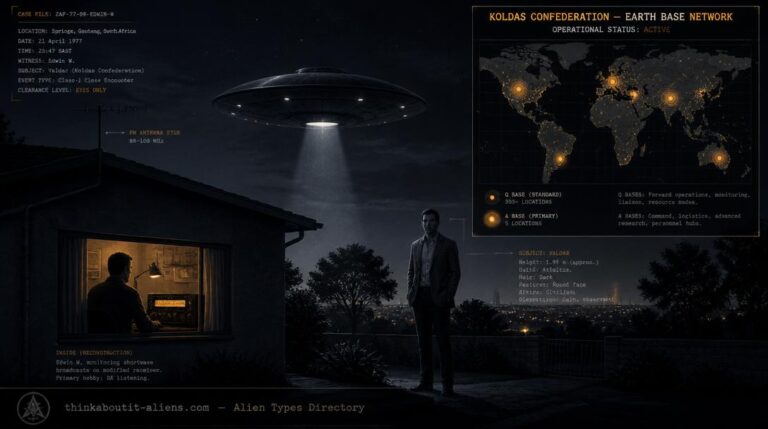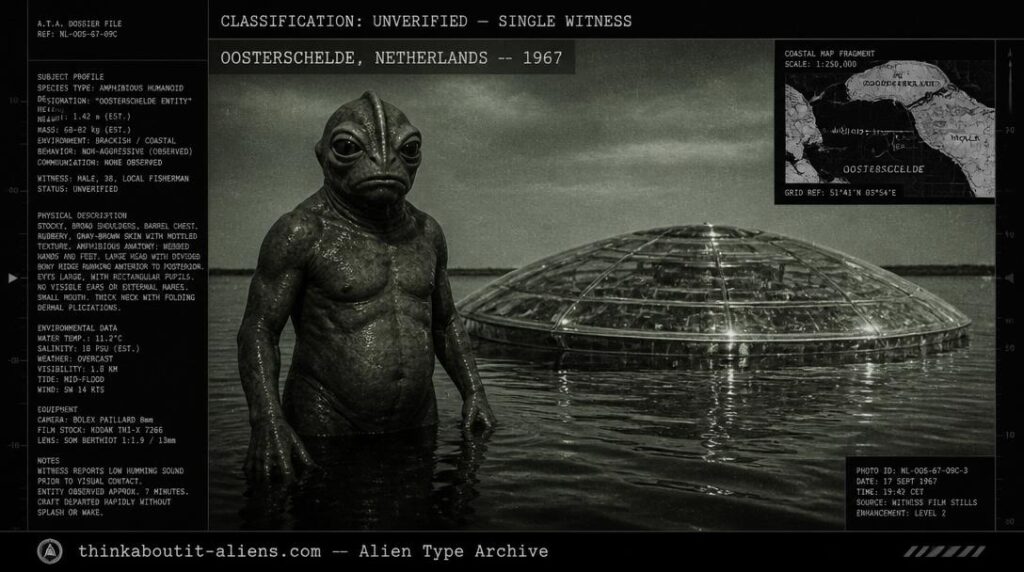
The Iarga entity as described in the Stefan Denaerde/Wendelle Stevens contact case.
THINK ABOUTIT’S ALIEN TYPE SUMMARY
Iarga
Few contactee accounts come with the paper trail the Iarga case does: a Dutch industrialist’s 1969 story published deliberately as fiction, a decade of quiet follow-up, and a 1982 English edition from veteran investigator Wendelle C. Stevens naming it fact. The Iargans are amphibious, water-world humanoids whose entire profile rests on one witness — “Stefan Denaerde,” a pseudonym — and the details he gave of a green, mist-lit planet run on what he called “Cosmic Economics.” This entry separates what Denaerde and his investigators actually documented from numbers that were never part of the record.
Name: Iarga
AKA: The Iargans, Stef Denaerde Entities
Location – Home System: The planet Iarga, said to be inhabited by a highly advanced society, both technologically and spiritually. Supposedly some 10 light years from Earth. Described as a green planet with a population 100 times larger than Earth’s, greater diameter and mass, stronger surface gravity, a thicker and differently-composed atmosphere, and a permanent high-altitude mist layer that filters sunlight — no direct sunlight, moon, or stars are visible from the surface. Rotation is slower, giving longer days and nights, though light reflected off the planet’s rings can turn some nights bright. Wind speeds are described as up to three times Earth’s maximum and precipitation up to ten times greater, with a higher terminal velocity making falls or storms far more dangerous than on Earth.
Distance from Earth: Approximately 10 light years (per the witness; unconfirmed).
Attitude: Peaceful, philosophical, and communal, per the witness’s account.
Motives: Described in-story as focused on cosmic integration, selfless service, and a resource-sharing system the Iargans reportedly called “Cosmic Economics.”
Physical Appearance: Stocky, muscular bipedal amphibians with rubbery-textured skin, per Denaerde’s description.
- Average Height: Described only as “a little larger than us” in the original investigation summary, with one secondary compilation rendering this as “approximately five feet tall.” No inch-range measurement appears in any source. (Corrected — see Researcher’s Notes.)
- Average Weight: Not specified for the Iargans in any source. (Corrected — see Researcher’s Notes: the “220–250 lbs” figure previously listed here belonged to the human witness, not the aliens.)
- Body Temperature: Not specified in any source. (Removed — see Researcher’s Notes.)
- Pulse/Respiration: Not specified in any source. (Removed — see Researcher’s Notes.)
- Blood Pressure: Not specified in any source. (Removed — see Researcher’s Notes.)
- Life Expectancy: Not specified in any source. (Removed — see Researcher’s Notes.)
- Hair: Described as short, smooth hair with a sheen “like a furry animal,” in colors ranging from rust-brown to silver-gray.
- Skin: Hairless, with a pale, glasslike sheen; darker gray-brown along the edges of the face, and described by the witness as appearing to shift with reflected light and shadow.
- Eyes: Large and luminous, with distinct rectangular pupils the witness described as having a hypnotic, “quizzical” quality.
- Sex: Male and female described; the account presents Iargan society as built on total gender equality.
Other Physical Information: Bipedal and broadly humanoid, described as originally amphibian, with webbed fingers and toes. The witness described longer arms, dense rubbery muscle, and claw-like hands with an exceptionally strong grip; a bony ridge running down the center of the skull into a groove on the forehead, giving the impression of a two-part skull; and a heavier neck and shoulder structure than a human’s. Teeth were described as two seamless white strips closing in a scissor-like bite.
Special Traits and Abilities: Bony skull ridge, rectangular pupils, and unusually strong claw-like hands, per the witness’s description.
Communication Type: Described in the account as both verbal and telepathic, including later long-distance mental contact reported by the witness after the initial encounter.
Origin: The planet Iarga, described as a high-gravity, water-dominant world.
Life Form Type: Bipedal, near-humanoid amphibian, per the witness’s account.
Subspecies: None reported; the account describes a single unified planetary population.
Most Common Species: Amphibious humanoid (as described in this single account; not an independently verified taxonomic category).
Level of Species: Presented in-story as a spiritually and technologically advanced interstellar civilization. This site does not apply a numbered “Level” classification, as no such scale appears in any primary or secondary source for this case. (Corrected — see Researcher’s Notes.)
Habits: Described as a highly communal, resource-sharing society organized around the witness’s term “Cosmic Economics.”
Transportation Type: Described in-account: extensive transoceanic rail systems on Iarga, and disc-shaped spacecraft used for interstellar travel.
Witnesses Reports: “Stefan Denaerde” (pseudonym for a Dutch industrialist), with investigation and English-language publication by Lt. Col. Wendelle C. Stevens, and further case investigation summarized by Rune Øverby.
Special Features/Characteristics: Three-fingered, claw-like hands with an unusually strong grip; a distinctive dual-compartment skull ridge.
Related Cases: No confirmed connections to other entries in this archive. Thematically, it belongs to a wave of late-1960s/1970s European “benevolent contact” narratives describing advanced, human-adjacent societies critiquing Earth’s development — a pattern also seen in other utopian-contactee literature of the era.
DETAILED REPORT
The Iarga case began, according to the witness, in July 1967, when a Dutch industrialist sailing the Oosterschelde in the Netherlands encountered a metallic object in the water and was subsequently brought aboard a spacecraft, where he spent close to eight hours in contact with its occupants. He kept the experience secret for roughly two years, working privately with an illustrator, Rudolf Dass, to prepare drawings of what he had seen. When the story was first published in Dutch as Buitenaardse Beschaving, it was presented as science fiction — reportedly at the publisher’s own suggestion, given how unbelievable the account would otherwise seem.
In the late 1970s, retired USAF Lieutenant Colonel Wendelle C. Stevens — already a well-known UFO investigator and author — traveled to Europe, learned of the case, and met with the witness. Stevens described several years of follow-up investigation, during which the witness reported additional long-range telepathic contact with the Iargans that continued for years after the original encounter. Stevens compiled the original account together with this new material into UFO…Contact from Planet Iarga: A Report of the Investigation, published in English in 1982, running 365 pages. The book presents the original 1967 material as “Part I” and the newer, previously unpublished follow-up communications as “Part II.”
The witness’s chosen alias, “Stefan Denaerde,” was explained as a rendering of “Stef van den Aerde” (“Stef of the Earth”) — a name the Iargans themselves reportedly used for him. Descriptions of the witness circulated by investigators note that he was a mechanical engineer and industrialist, roughly 6’4″ tall and weighing 220–230 pounds — details worth flagging because, as covered below, later web compilations of this case appear to have mixed up the witness’s own measurements with the alien species’ physical profile.
The planet itself is described through the witness’s testimony as a green, mist-shrouded, high-gravity water world with a thicker atmosphere than Earth’s, no visible sun, moon, or stars, more extreme wind and precipitation, and a society Denaerde called “Cosmic Economics” — a moneyless, fully egalitarian economic and political system distinct from communism or capitalism, organized around what the witness described in explicitly spiritual, “Christian love”-inflected terms. New Age author Joshua David Stone later summarized and repeated much of this material in his own writing on extraterrestrial civilizations, without adding independent verification.
Investigator Rune Øverby, who hosted an extended version of the book’s material online, offered a personal assessment of the witness’s credibility — describing him as an articulate engineer and architectural artist, “not known to tell fictitious stories,” and by profession well suited to conveying complex technical information accurately if the contact occurred as described. This assessment, along with large portions of the book’s descriptive text, has since been mirrored nearly verbatim across a number of UFO and New Age websites, making Øverby’s page (and the original Stevens/Denaerde book) the effective single point of origin for nearly all downstream summaries of this case, including this site’s own.
RESEARCHER’S NOTES
The Iarga — Netherlands, 1967 and Contact-Era Utopianism
- Classification correction: This entry previously listed quantified biometrics — a height range, a weight range, body temperature, pulse/respiration, blood pressure, and a life expectancy of “150–200 years” — none of which appear anywhere in the Stevens/Denaerde book, Rune Øverby’s investigation summary, or any downstream compilation checked for this audit. The weight figure in particular (“220–250 lbs”) appears to be a straightforward mix-up: that number belongs to the human witness’s own described build (6’4″, 220–230 lbs), not the Iargans. A “Level III” species-classification label was also invented; no such scale is used anywhere in the sourcing. All of these have been removed or marked as unsourced rather than carried forward.
- Source chain assessment: The case traces to one witness (pseudonymous), investigated and published in English by Wendelle Stevens in 1982. Rune Øverby’s web summary of the book is the version from which the large majority of other online accounts — including the version this site previously ran — draw their wording almost word for word. This is a single-source case with one layer of named investigation, not multiple independent contact reports.
- Evidentiary weight: The account is uncorroborated testimony from an anonymized witness, originally released as fiction for market reasons and only later reframed as a factual report. Its second half rests on the witness’s self-reported ongoing telepathic contact, which by nature cannot be independently checked. It should be read as a documented piece of contactee literature, not as verified extraterrestrial contact.
- Pattern context: Iarga fits a recognizable subgenre of 1960s–80s contactee narratives: an advanced, human-adjacent, spiritually evolved civilization delivering gentle criticism of Earth’s warlike and materialistic tendencies, paired with a utopian economic system presented as a model for humanity. The “Cosmic Economics” framing is distinctive to this case but shares its moral structure with other contact-era utopian societies described in the same literature.
- Geographic/historical context: The 1967 encounter is set on the Oosterschelde in the Netherlands during a period the investigation itself describes as one of heavy global UFO reporting activity. The book’s English publication came 15 years later, via a small specialty UFO press (UFO Photo Archives, Tucson, AZ) associated with Stevens.
The Iarga case is one of ufology’s more elaborate single-witness contact narratives — a fully realized alien society, published first as fiction and only later claimed as fact, propagated online almost entirely through one investigator’s summary of the source book. What’s verifiable is the publication history and the described narrative; what isn’t is the extraterrestrial contact itself. This entry keeps the story faithful to what Denaerde, Stevens, and Øverby actually said, and drops the invented statistics that had crept in around it.
“These beings may look strange to us in appearance, but not in terms of what lives in their hearts and consciousness.”
About the Author