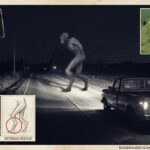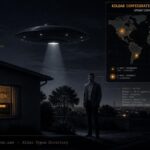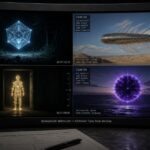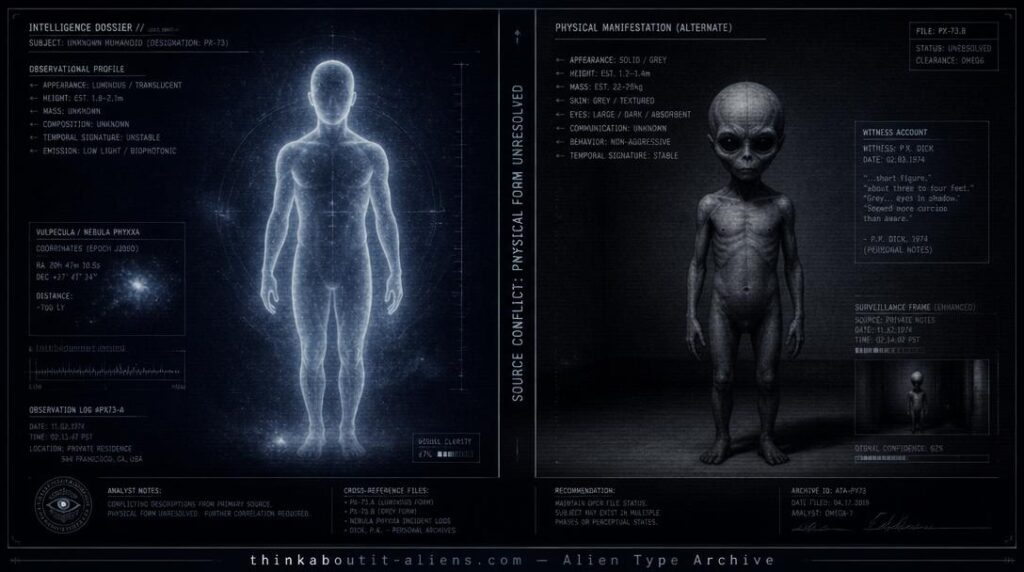
The Shining Ones, or Moovianthan-Kayphik — described as a luminous guardian by one source and a small Grey by another.
THINK ABOUTIT’S ALIEN TYPE SUMMARY
SHINING ONES
In the Think About It Alien Database, the Shining Ones — also called the Moovianthan-Kayphik — are documented across four distinct sources that do not fully agree with one another: Santori’s Alien Races Book, a compiled Bibliotecapleyades article describing luminous “shining beings” encountered by Tibetans, American Indians, and science-fiction writer Philip K. Dick, a book by SSP veteran El (Ileana) Ka, and Elena Danaan’s A Gift from the Stars — which describes them not as beings of pure light, but as small Greys with hollow eyes. This entry preserves all four accounts and their contradictions rather than collapsing them into one.
Name: Shining Ones
AKA: Moovianthan-Kayphik; Moovianthan Kay Phixaka; Moovianthan Kay Phixakaazarek (per El Ka).
Location – Home System: The Vulpecula constellation, per Santori’s ARB. El Ka and Danaan both specify the Nebula Phykxa within Vulpecula; Danaan further identifies this as NGC 6940 — though mainstream astronomy classifies NGC 6940 as an open star cluster, not a nebula, a discrepancy Muller’s guide itself flags.
Distance from Earth: 297 light years, per Santori’s ARB.
Attitude: Described in the Bibliotecapleyades source as benevolent and instructional, appearing during isolated, sacred religious rituals. Danaan’s account gives no attitude description beyond noting cooperation with the Orion Alliance as part of a “Grey Collective.”
Motives: Per Santori’s ARB: meeting with two unnamed U.S. presidents and Soviet/Russian leaders to “provide limited technology in exchange for abducting humans,” with the specific claim that they “do not involve other races in their abductions.” Per the Bibliotecapleyades source: guarding the sacred sites of Earth and holding wisdom in trust. No source reconciles these two accounts.
Physical Appearance: Two contradictory descriptions exist. The Bibliotecapleyades source describes luminous, “lit from within” humanoid beings encountered by Tibetans and American Indians. Danaan describes them instead as “small Greys” with “hollow eyes,” part of a broader “Grey Collective.” This entry does not resolve the contradiction in favor of either account.
- Average Height: Undocumented as a specific figure in any source consulted.
- Average Weight: Undocumented.
- Body Temperature: Undocumented.
- Pulse/Respiration: Undocumented.
- Blood Pressure: Undocumented.
- Life Expectancy: Undocumented.
- Hair: Undocumented.
- Skin: Undocumented beyond the “lit from within” description in the Bibliotecapleyades source, which is not corroborated by Danaan’s separate “small Grey” description.
- Eyes: “Hollow eyes,” per Danaan specifically — no eye description appears in the Bibliotecapleyades source.
- Sex: Undocumented.
Other Physical Information: Undocumented beyond the two contradictory descriptions above.
Special Traits and Abilities: Interdimensional travel ability, per Danaan, which she states is the actual source of the “Shining Ones” name — though she does not clarify the connection between interdimensional travel and the name itself.
Communication Type: Per Philip K. Dick’s own account (see Detailed Report): a “computer-like or Artificial Intelligence system” voice, neither male nor female, imposed alongside a distinct personality.
Origin: The Vulpecula constellation (Santori’s ARB); more specifically the Nebula Phykxa/NGC 6940 within it (El Ka; Danaan).
Life Form Type: Contradictory across sources: luminous humanoid (Bibliotecapleyades) versus small Grey (Danaan). No source classifies them as a “Bio-Photonic AI Hybrid” — that designation does not appear anywhere in the material reviewed for this entry.
Subspecies: Undocumented.
Most Common Species: Undocumented.
Level of Species: Undocumented; no numbered ranking appears in any source consulted.
Habits: Per Santori’s ARB: they have “colonized over 40 planets outside of our solar system” (no specifics given) and “played a big role in Siberian and Tibetan culture,” maintaining hidden bases in north-facing mountains there. Per the Bibliotecapleyades source: appearing to witnesses during isolated, secret religious rituals.
Transportation Type: Undocumented beyond Danaan’s general reference to interdimensional travel capability.
Witnesses Reports: Tibetan and American Indian religious practitioners; abductee Betty Andreasson; science-fiction author Philip K. Dick, whose documented account is detailed below.
Special Features/Characteristics: Described by Philip K. Dick as behaving like a “master game player and magician and trickster.”
Summary/Description: The Shining Ones, or Moovianthan-Kayphik, are documented across several sources that do not agree on their basic nature. Santori’s ARB describes a Vulpecula-based species that colonized dozens of planets, met with unnamed heads of state to trade limited technology for permission to abduct humans, and has historical ties to Siberian and Tibetan culture. A separate, widely circulated source (Bibliotecapleyades) describes luminous “shining beings” who guard Earth’s sacred sites and have been encountered by Tibetan and American Indian practitioners, by abductee Betty Andreasson, and — most extensively documented — by science-fiction author Philip K. Dick, whose real, well-documented “2-3-74” visionary experience is detailed below. Elena Danaan’s separate account describes them instead as small Greys with hollow eyes, part of a “Grey Collective” cooperating with the Orion Alliance — directly contradicting the luminous-being description.
Source: Santori’s Alien Races Book (2011), p. 26; “Shining Ones” in Alien Races, Bibliotecapleyades website; El (Ileana) Ka, Cosmic History of Us Galactic Humans in the Milky Way and Andromeda Galaxies, Vol. 2; Elena Danaan, A Gift from the Stars (2020); Philip K. Dick’s own published Exegesis and letters describing his 1974 “2-3-74” experience.
Related Cases: The Rak/Raki, another entity documented in the same compiled source lineage as originating from the Vulpecula constellation; Philip K. Dick’s VALIS (Vast Active Living Intelligence System) writings and the published Exegesis of Philip K. Dick (2011).
DETAILED REPORT
The “Shining Ones” entry rests on four sources that describe meaningfully different things under the same name. Santori’s ARB places them in the Vulpecula constellation, credits them with colonizing more than 40 planets, and makes the specific claim that they met with two unnamed U.S. presidents and Soviet/Russian leaders to trade limited technology for permission to abduct humans — while “not involving other races in their abductions.” No dates, names, or further detail accompany any of these claims. The ARB separately states they “played a big role in Siberian and Tibetan culture” and maintain hidden bases in north-facing mountains there, again without examples.
A second source, a compiled article on the Bibliotecapleyades website, describes something quite different: luminous, “lit from within” beings encountered by Tibetans and American Indians during isolated religious rituals, tasked with guarding Earth’s sacred sites. This source specifically names abductee Betty Andreasson as a witness and gives an extensive account of science-fiction author Philip K. Dick’s encounter.
Dick’s experience is itself real and well-documented independent of any ufology source. Beginning in February–March 1974 — a period he came to call “2-3-74,” not 1978 as an earlier draft of this page stated — Dick experienced a series of intense visions, including an information-rich “pink beam” of light, following minor dental surgery. He described hearing a voice he characterized as “computer-like or Artificial Intelligence system,” neither male nor female, which he called “the most beautiful sound I ever heard,” alongside a sense that another personality had been imposed on his own. He continued writing about these experiences until his death on March 2, 1982 — an eight-year period, not the four years an earlier draft claimed — producing what became known as his Exegesis, roughly 8,000 handwritten pages, a small portion of which was edited and published in 2011. Dick fictionalized aspects of the experience in his VALIS trilogy of novels. This material is genuinely Dick’s own; whether it constitutes evidence of contact with the “Shining Ones” specifically, rather than a documented and much-studied personal and literary phenomenon in its own right, is an interpretive leap made by the ufology sources that cite him, not something Dick’s own writing itself establishes.
The third and fourth sources — El Ka’s book and Elena Danaan’s A Gift from the Stars — refine the Vulpecula origin to a specific location, the Nebula Phykxa, which Danaan identifies as NGC 6940. Mainstream astronomy classifies NGC 6940 as an open star cluster rather than a nebula, a discrepancy also noted in Muller’s guide. More significantly, Danaan’s physical description directly contradicts the luminous-being account: she describes the Moovianthan Kay Phixaka as “small Greys” with “hollow eyes,” members of a “Grey Collective” cooperating with the Orion Alliance. She states their interdimensional travel ability is the actual source of the “Shining Ones” name, without explaining the connection. Much of the rest of her account is an uncredited repetition of Santori’s ARB.
None of the four sources describes a “Bio-Photonic AI Hybrid” classification, phosphene-based neural interface technology, personality-imposition as a named ability, or a 2026-specific reclassification narrative. These do not appear anywhere in the material reviewed for this entry.
RESEARCHER’S NOTES
Shining Ones — Four Sources That Do Not Agree, Kept Honest Rather Than Merged
- Two sources flatly contradict each other on physical form: Bibliotecapleyades describes luminous light-beings; Danaan describes small Greys with hollow eyes. Rather than picking a winner, this entry presents both and flags the conflict directly.
- Philip K. Dick’s dates were wrong in the earlier draft: his documented “2-3-74” experience began in February–March 1974, not 1978, and the Exegesis spans roughly eight years to his 1982 death, not four. These are independently verifiable facts about a real, well-studied literary figure, not interpretive judgment calls.
- Santori’s ARB contains substantial real content the earlier draft omitted entirely: the 40-planet colonization claim, the presidential/Soviet meetings, and the technology-for-abduction exchange are all part of the documented source and were left out of the previous draft in favor of invented “2026 Disclosure” material.
- An astronomy error traces to Danaan’s own source, not to this archive: NGC 6940 is a real open star cluster, not a nebula; Muller’s guide notes this same discrepancy in Danaan’s identification.
- “Bio-Photonic AI Hybrid” is an invented classification: it appears in none of the four sources and was added without support in a previous draft.
The honest state of this entry is that “Shining Ones” is not one consistent, documented species but a name attached to at least two incompatible descriptions across four real sources. Rather than smoothing that over, this entry keeps the contradiction visible — a small Grey with hollow eyes according to one channeled source, a luminous guardian of sacred sites according to another, with Philip K. Dick’s genuinely documented visionary experience sitting, unresolved, in between.
“…within my head it communicated with me in the form of a computer like or Artificial Intelligence system like voice, quite different from any human voice, neither male nor female, and a very beautiful sound it was, the most beautiful sound I ever heard.”
— Philip K. Dick, from his letters describing the “2-3-74” experience
About the Author