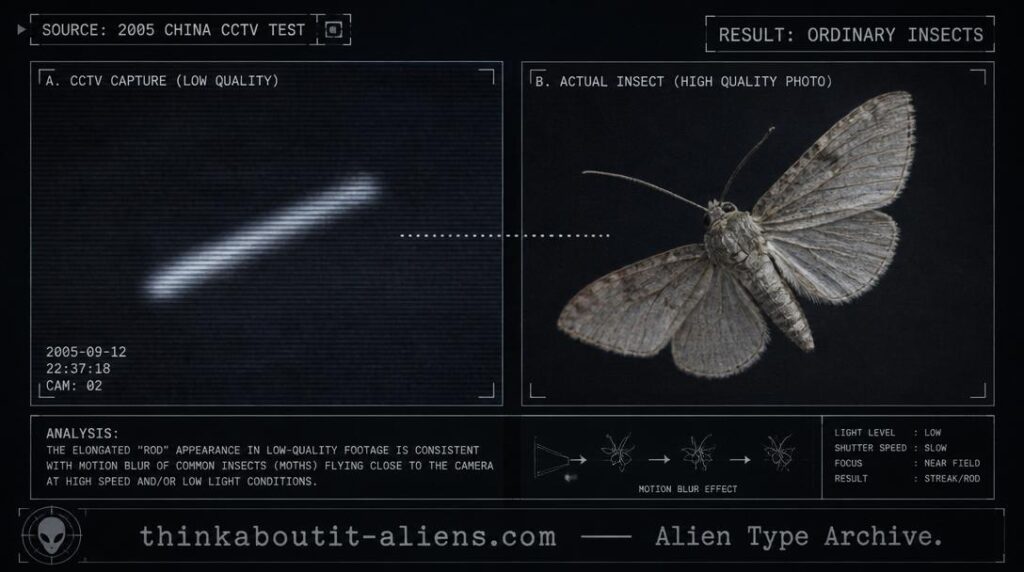
A side-by-side comparison illustrating the motion-blur explanation for "rods," supported by the 2005 China CCTV test that captured only ordinary moths.
THINK ABOUTIT’S ALIEN TYPE SUMMARY
TUBES, RODS, SKYFISH
Unlike most entries in this archive, “rods” is not a case of thin or absent evidence — it is a case that has actually been tested, more than once, with a consistent result. In 2005, surveillance cameras at a Chinese pharmaceutical facility captured “rods” identical to those filmmaker José Escamilla popularized in 1994. Curious staff strung up nets to catch one. What they caught were ordinary moths. This entry presents that history plainly, alongside the genuine optical-motion-blur explanation that mainstream analysis has consistently supported, rather than treating the “unknown atmospheric organism” idea as settled fact.
Name: Rods (also called “Skyfish” or “Tubes” in some sources)
AKA: Skyfish, Solar Entities. “Atmospheric Plasmoids” and “Tubes” as a distinct large-scale “subspecies” are terms specific to this entry’s own recent embellishment and are not part of the phenomenon’s documented history.
Location – Home System: Not applicable. This is a phenomenon documented on video and in photographs, not a reported extraterrestrial contact case with a claimed origin point.
Distance from Earth: Not applicable
Attitude: Not applicable in the sense used elsewhere in this archive; the mainstream explanation identifies “rods” as an optical artifact of ordinary flying insects and birds, not a behaviorally distinct entity
Motives: Not applicable
Physical Appearance: As it appears on camera: an elongated, rod-shaped form with undulating, wing-like side patterns, typically a few centimeters to roughly a meter in apparent length. The mainstream, well-supported explanation is that this appearance is produced by motion blur: a fast-moving insect’s rapidly beating wings (some species beat up to 60 times per second), combined with forward flight speed, create a streaked, sinusoidal pattern under slow shutter speeds or interlaced video recording — an insect in flight, not a solid-bodied creature.
- Average Height: Not applicable; apparent length in footage ranges from a few centimeters to roughly a meter, consistent with the motion-blur explanation rather than a fixed body size
- Average Weight: Not applicable
- Body Temperature: Not applicable
- Pulse/Respiration: Not applicable
- Blood Pressure: Not applicable
- Life Expectancy: Not applicable
- Hair: Not applicable
- Skin: Not applicable
- Eyes: Not applicable
- Sex: Not applicable
Other Physical Information: Claims that rods can pass through solid rock or water without losing velocity are not independently documented; the sources reviewed for this correction describe rods appearing near caves and water, not passing through solid barriers.
Special Traits and Abilities: Undocumented as a distinct biological trait. Reported “velocities” of 300+ mph are Escamilla’s own early estimate based on his footage, not an independently confirmed measurement, and are not consistent with the motion-blur explanation, which requires only ordinary insect flight speeds combined with camera shutter timing to produce the visual effect.
Communication Type: Not applicable
Origin: Not applicable as an extraterrestrial or extra-dimensional origin claim; the phenomenon’s actual origin, as a subject of study, traces to José Escamilla’s March 1994 footage near Roswell and Midway, New Mexico
Life Form Type: Disputed. Escamilla and some proponents have argued for an undiscovered biological life form; the mainstream, tested explanation identifies “rods” as a visual artifact of ordinary insects (and in some cases birds or bats), not a distinct organism.
Subspecies: Undocumented. A formal “Rods/Skyfish/Tubes” size hierarchy does not appear in the phenomenon’s documented history and represents unsupported recent embellishment.
Most Common Species: Not applicable
Level of Species: Not applicable; no such classification exists in any source reviewed
Habits: “Rods” are most often reported in footage from caves, near water, and in outdoor daylight video generally — settings that also happen to be common habitats for fast-flying insects such as moths and dragonflies, consistent with the mainstream explanation
Transportation Type: Not applicable
Witnesses Reports: José Escamilla (1994, near Roswell/Midway, New Mexico, the original and most prominent proponent); UFO investigator Robert Sheaffer, who attended an Escamilla lecture and identified specific examples in Escamilla’s own footage as ordinary insects and blurred bird wings; a 2005 China Central Television investigation at a facility in Tonghua City, Jilin Province, where identical “rods” were captured on surveillance video and subsequently netted, yielding only ordinary moths and insects
Special Features/Characteristics: No physical specimen of a “rod” as a distinct organism has ever been recovered. Every documented attempt to physically capture one — including the 2005 China CCTV investigation and subsequent efforts — has yielded ordinary insects.
Summary/Description: “Rods,” also called “skyfish,” are elongated, undulating shapes that appear in video and photographic footage, popularized by filmmaker José Escamilla after he noticed them in 1994 footage shot near Roswell, New Mexico. While Escamilla and some proponents have promoted the idea that they represent an undiscovered atmospheric life form, the mainstream and repeatedly tested explanation is that they are a motion-blur artifact produced when fast-flying insects pass close to a camera under slow shutter speeds or interlaced recording — an explanation supported directly by a 2005 Chinese investigation that captured and identified the source insects on camera.
Source: José Escamilla’s original 1994 footage and subsequent documentaries (including Rods: Mysterious Objects Among Us!, 1997); Robert Sheaffer’s skeptical analysis; China Central Television’s 2005 two-part investigation; Wikipedia’s “Rod (optical phenomenon)” entry and related mainstream science coverage
Related Cases: A 2012 report from a British traveler claiming to have found “rods” in a cave in Sabah, Malaysia — a claim that, consistent with the pattern of prior investigations, did not result in a recovered specimen distinct from known insects
DETAILED REPORT
Filmmaker José Escamilla first noticed “rods” in March 1994 while reviewing footage he had shot near Roswell and Midway, New Mexico, while attempting to film a UFO. The shapes — off-white, oblong, and appearing to move through the frame with an undulating, fin-like motion — had not been visible to him during filming, only on playback. He went on to promote them extensively, releasing the documentary Rods: Mysterious Objects Among Us! in 1997 and touring to present his footage, at points speculating that “rods” might be a surviving relative of Anomalocaris, an extinct Cambrian-era predator — a specific, personal theory of his, not a documented finding.
The mainstream analysis of this material, developed over three decades by skeptics and scientists alike, is specific and testable: fast-flying insects — moths, dragonflies, and similar species — beat their wings dozens of times per second while moving through the air at several meters per second. When such an insect passes close to a camera recording at a slow shutter speed or using interlaced video, the repeated wing positions blur together into a continuous, sinusoidal streak, creating the visual impression of a single elongated body with a row of fin-like appendages along its length. UFO investigator Robert Sheaffer, after attending one of Escamilla’s own lectures, wrote that some of the footage Escamilla presented was “obviously insects zipping across the field at a high angular rate,” while other examples were blurred bird wings.
This explanation was tested directly, not merely argued. In 2005, China Central Television aired a two-part documentary covering an incident at a pharmaceutical facility in Tonghua City, Jilin Province, where surveillance cameras had captured “rods” visually identical to Escamilla’s footage. Facility staff, curious to identify the source, set up nets to physically capture whatever was producing the effect. The nets caught ordinary moths and other common flying insects — nothing resembling a distinct “rod” organism. Subsequent efforts elsewhere, including high-speed camera studies, have consistently reproduced the same result: when recording conditions are improved, “rods” resolve back into ordinary insects, birds, or bats.
RESEARCHER’S NOTES
A Rare Case in This Archive: Actually Tested, Not Just Undocumented
- Source Chain Assessment: Most entries in this archive suffer from a lack of testable evidence. This one is different — “rods” have been directly, physically tested multiple times, with a consistent result each time. That changes how this entry should be written: not as an open question awaiting more data, but as a documented phenomenon with a well-supported explanation.
- Fabricated Biology and Technology Panel: Claims of a “pressurized fluidic core,” “plasma-based metabolism,” phase-shifting through solid rock, and feeding on “atmospheric ions” or “radioactive leakage” do not appear in any source reviewed and have been removed entirely. These read as invented elaboration with no basis in either Escamilla’s own claims or the mainstream analysis.
- Fabricated Classification System: A three-tier “Rods/Skyfish/Tubes” size hierarchy, a “Technical Tier 0” rating, and “2026 Mandate” origin classification do not appear in any source and have been removed.
- The Decisive Test Restored: The 2005 China CCTV investigation — in which nets set up to catch a “rod” caught only ordinary moths — is the single most important piece of evidence regarding this phenomenon, and it was entirely absent from the previous version of this page. It has been restored here as the centerpiece of this entry’s evidentiary discussion.
- Evenhandedness Note: Unlike most entries in this archive, this topic has a well-supported mainstream scientific explanation, tested and confirmed through direct physical investigation. This entry presents that explanation as the best-supported account, consistent with how established, testable claims should be handled, while still accurately describing Escamilla’s own promoted view and giving him credit for popularizing the phenomenon.
What “rods” actually demonstrate is not a hidden atmospheric ecology, but something almost as interesting: how easily a genuine, camera-specific optical artifact can be mistaken for a new kind of animal, and how directly that mistake can be tested and resolved once someone bothers to put out a net.
“Some of his ‘rods’ were obviously insects zipping across the field at a high angular rate.”
— Robert Sheaffer, UFO investigator, on José Escamilla’s footage.
About the Author