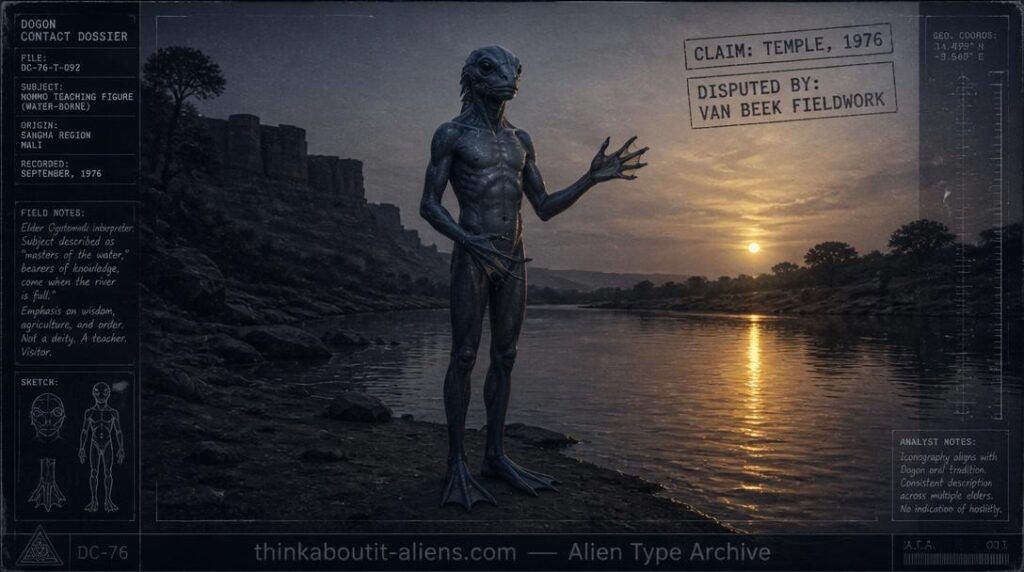
The Nommo, per Dogon tradition: teachers, not aggressors — a framing lost in later retellings of Robert Temple's Sirius Mystery.
THINK ABOUTIT’S ALIEN TYPE SUMMARY – Amphibians
The Dogon people of Mali have a centuries-old tradition describing the Nommo — amphibious ancestor-teachers who came from the sky. In 1976, author Robert Temple argued this proved the Dogon had genuine ancient knowledge of Sirius B, a star invisible to the naked eye. It’s one of ufology’s most cited claims — and one of its most directly disputed by researchers who actually did the anthropological fieldwork.
Name: Amphibians
AKA: Nommo (the Dogon tradition’s own name for these beings). “Alpha Centaurians” is used interchangeably in some circulating retellings, but that name belongs to a separate, distinctly sourced entry on this site and shouldn’t be treated as the same type.
Location – Home System: Sirius, per Temple’s interpretation of Dogon tradition; specifically Sirius B, the system’s white dwarf companion star
Distance from Earth: Approximately 8.6 light-years — the real astronomical distance to the Sirius system
Attitude: In Dogon tradition itself, the Nommo are described as teachers and civilizing ancestor-figures, not hostile entities. A hostile characterization appears in later ufological retellings, not in the original tradition.
Motives: In Dogon tradition, teaching and civilizing; later speculative retellings add resource extraction and military monitoring motives with no basis in the original material
Physical Appearance: Described in Dogon tradition as amphibious, humanlike beings associated with water. Specific measurements, coloration, and detailed anatomy are not part of the traditional account and appear only in later speculative additions.
- Average Height: Undocumented in the original tradition
- Average Weight: Undocumented
- Body Temperature: Undocumented
- Pulse/Respiration: Undocumented
- Blood Pressure: Undocumented
- Life Expectancy: Undocumented
- Hair: Undocumented
- Skin: Described generally as amphibious in tradition; webbed extremities are part of the traditional description
- Eyes: Undocumented
- Sex: Undocumented
Other Physical Information: Described as amphibious, with humanoid and fish- or amphibian-like features, per Dogon tradition as interpreted by Temple
Special Traits and Abilities: None specifically documented in the traditional Nommo account beyond their described role as civilizing teachers
Communication Type: Undocumented
Origin: Sirius, per Temple’s interpretation of Dogon tradition
Life Form Type: Amphibious humanoid
Subspecies: Undocumented; the “Centaurian Gill-men” designation belongs to an unrelated, separately sourced conflation and shouldn’t be treated as part of the Nommo tradition
Most Common Species: Nommo, per Dogon tradition
Level of Species: Undocumented
Habits: Described in Dogon tradition as teachers who imparted civilizing knowledge; specific modern claims about diet, cave-dwelling near the Bahamas or Yucatan, etc. are later additions with no basis in the original tradition
Transportation Type: Not part of the traditional Nommo account; later retellings associate the type with modern “USO” (unidentified submerged object) reports, without a direct documented connection between the two
Witnesses Reports: The primary source is the Dogon people’s own oral tradition, as documented and interpreted by Robert Temple in The Sirius Mystery (1976), which argued Dogon astronomical knowledge of Sirius B proved ancient extraterrestrial contact. This interpretation has been directly disputed: anthropologist Walter van Beek, who conducted his own fieldwork with the Dogon, reported finding no evidence of the specific Sirius B knowledge Temple described, and suggested the astronomical details may trace to 20th-century contact with Western missionaries and astronomers who visited the Dogon before Temple’s research — not ancient tradition. Both the original claim and its direct scholarly rebuttal are part of the honest record here.
Special Features/Characteristics: None independently documented beyond the Nommo tradition itself
Summary/Description: The Nommo, amphibious ancestor-teacher figures in Dogon tradition, were interpreted by Robert Temple as evidence of ancient contact with beings from the Sirius system. That interpretation has been substantially challenged by later anthropological fieldwork questioning both the uniqueness and the antiquity of the Dogon’s Sirius B knowledge.
Source: Robert Temple, The Sirius Mystery (1976); Dogon oral tradition; critical fieldwork by anthropologist Walter van Beek
Related Cases: Not to be confused with this site’s separate Alpha Centaurians entry, which has its own distinct sourcing (Bielek, Collier, Klarer) unrelated to the Dogon/Nommo tradition
DETAILED REPORT
The Nommo/Sirius Mystery material is one of ufology’s most-cited “evidence” cases, and it deserves accurate treatment on both sides. Robert Temple’s 1976 book made a genuinely influential argument: that the Dogon’s traditional knowledge of Sirius B, a star invisible without a telescope, could only be explained by ancient contact with beings from that system. The claim spread widely.
What the previous version of this page left out entirely is that Temple’s claim has been directly and substantively challenged. Anthropologist Walter van Beek spent years doing his own fieldwork with the Dogon and reported he could not find the specific, detailed Sirius B knowledge Temple described as pre-existing tradition — and suggested it more likely traces to Dogon contact with 20th-century Western visitors, including missionaries and astronomers, prior to Temple’s own research. That’s not a fringe dismissal; it’s a peer-reviewed anthropological critique, and leaving it out lets a forty-year-old contested claim stand as though it were settled.
RESEARCHER’S NOTES
A Claim and Its Rebuttal — The Nommo, Temple, and van Beek
- Source Chain Assessment: Temple’s book is real and influential; the Dogon oral tradition itself is real and independently documented by anthropologists. The specific claim of ancient Sirius B knowledge is the contested part, not the existence of the Nommo tradition itself.
- Omitted Rebuttal: Van Beek’s fieldwork is a real, citable, direct challenge to Temple’s central claim and belongs in this entry as prominently as the original claim.
- Cross-Entry Naming Conflict: Listing “Alpha Centaurians” as interchangeable with the Nommo/Sirius material conflates two entirely separate sourcing traditions — this site’s own separate Alpha Centaurians entry draws on Bielek, Collier, and Klarer, none of whom discuss the Dogon or Sirius.
- Fabrication Scope: Biometrics, a “third eye” pineal sensor, specific Bahamas/Yucatan cave habitats, and detailed naval “Fast Mover” speed claims have no basis in either Temple’s book or the original Dogon tradition.
The Nommo tradition is real, and Temple’s interpretation of it is a genuinely significant piece of ufology history — but it’s a disputed piece, not a settled one. Presenting it without its most direct scholarly challenge did a disservice to readers trying to weigh the claim honestly. Both belong here together.
Temple argued Dogon tradition described visitors “from the Sirius star-system.”
(Robert Temple, The Sirius Mystery)
REMOVED CLAIMS (Archived for Reference)
These details appeared in an earlier version of this page with no basis in Temple’s book or Dogon tradition, or were presented without their documented scholarly challenge. Archived here rather than deleted.
- Omission of Walter van Beek’s fieldwork rebuttal — restored above
- Biometric data (height, weight, body temperature, pulse, blood pressure, life expectancy) — no source
- “Third eye” pineal electromagnetic sensor — no source
- Specific Bahamas/Yucatan Blue Hole habitats — no source
- Hostile, resource-extraction-motivated characterization — contradicts the Dogon tradition’s own framing of the Nommo as teachers
- Naval “Fast Mover” 400-knot speed claims attributed specifically to this type — no source connecting general USO naval reports to the Nommo/Sirius material specifically
- Interchangeable use of “Alpha Centaurians” — conflates this entry with a separate, distinctly sourced entry on this site
About the Author